Many people find their first actinic keratosis by touch before they ever see it. It’s a small, rough patch that feels like sandpaper, usually on the face, ears, scalp, or the back of a hand. It might flake off and come back, or sting a little when you wash your face. Because it doesn’t look like much, it’s easy to ignore.
But an actinic keratosis (AK) is a precancer. Most never become skin cancer, but some do, and there’s no way to tell by looking which ones will. The good news is that AKs are very treatable, and treating them is one of the simplest ways to lower your risk of skin cancer.
At Seacoast Dermatology, we diagnose and treat actinic keratoses every day for patients across the New Hampshire seacoast, Southern Maine, and the North Shore. Dr. Jonathan S. Glass, a board-certified dermatologist, explains what AKs are, who gets them, and how they’re treated.
What Is an Actinic Keratosis?
An actinic keratosis, also called a solar keratosis, is a patch of abnormal skin cells caused by years of ultraviolet (UV) exposure from the sun or tanning beds. “Actinic” refers to sunlight, and “keratosis” means a thickened, scaly growth.
UV damage adds up over a lifetime. Every sunburn, every afternoon on the water, and every summer of yard work leaves a little damage in the skin cells of the outer layer. Eventually some of those cells start growing abnormally, and an AK appears. That’s why AKs usually show up after age 40, even if most of the sun exposure happened decades earlier.
What Actinic Keratoses Look and Feel Like
- Rough, dry, or scaly texture, often easier to feel than to see
- Pink, red, tan, or skin-colored, usually a few millimeters across, though they can be larger
- On sun-exposed skin: the face, nose, ears, balding scalp, lips, neck, forearms, and the backs of the hands
- Spots that come and go, flaking off and then returning in the same place
- Mild itching, burning, or stinging, especially when touched or washed
Some AKs become thick and crusty (hypertrophic AKs), and occasionally one forms a small horn-like projection. When AKs develop on the lips, usually the lower lip, the condition is called actinic cheilitis. It looks like a persistently dry, scaly, or whitish patch, or a blurring of the edge between the lip and the surrounding skin. Lip balm doesn’t fix it, and it deserves a dermatologist’s attention.
Why Actinic Keratoses Matter
Any single AK has a low chance of turning into cancer. The concern is that AKs are the most common starting point for squamous cell carcinoma, the second most common skin cancer, and many people have more than one. There’s no reliable way to predict which spot will progress, which is why dermatologists treat them rather than wait.
AKs are also a signal. If you have them, your skin has had enough UV exposure to raise your risk of every type of skin cancer, including basal cell carcinoma and melanoma. The spots you can see are often surrounded by sun-damaged skin that hasn’t formed a visible lesion yet. Dermatologists call this field damage, and it’s why treatment sometimes covers a whole area rather than a single spot.
Who Gets Actinic Keratoses?
Anyone with significant sun exposure can develop AKs, but they’re most common in people who:
- Have fair skin, light eyes, or red or blond hair, or who burn easily
- Are over 40, especially men with thinning hair or a bald scalp
- Have a history of sunburns or tanning bed use
- Work or spend free time outdoors: fishermen and lobstermen, sailors and boaters, landscapers, farmers, construction workers, golfers, and runners
- Have a weakened immune system, for example after an organ transplant or while taking immunosuppressive medication
- Have had skin cancer before
Life on the Seacoast adds up. Sun reflecting off the water at Hampton Beach, the Piscataqua, or Great Bay increases exposure, and so does sun off snow during the winter. Years of boating, beach days, and outdoor work are a big part of why we see so many AKs in our patients.
How Actinic Keratoses Are Diagnosed
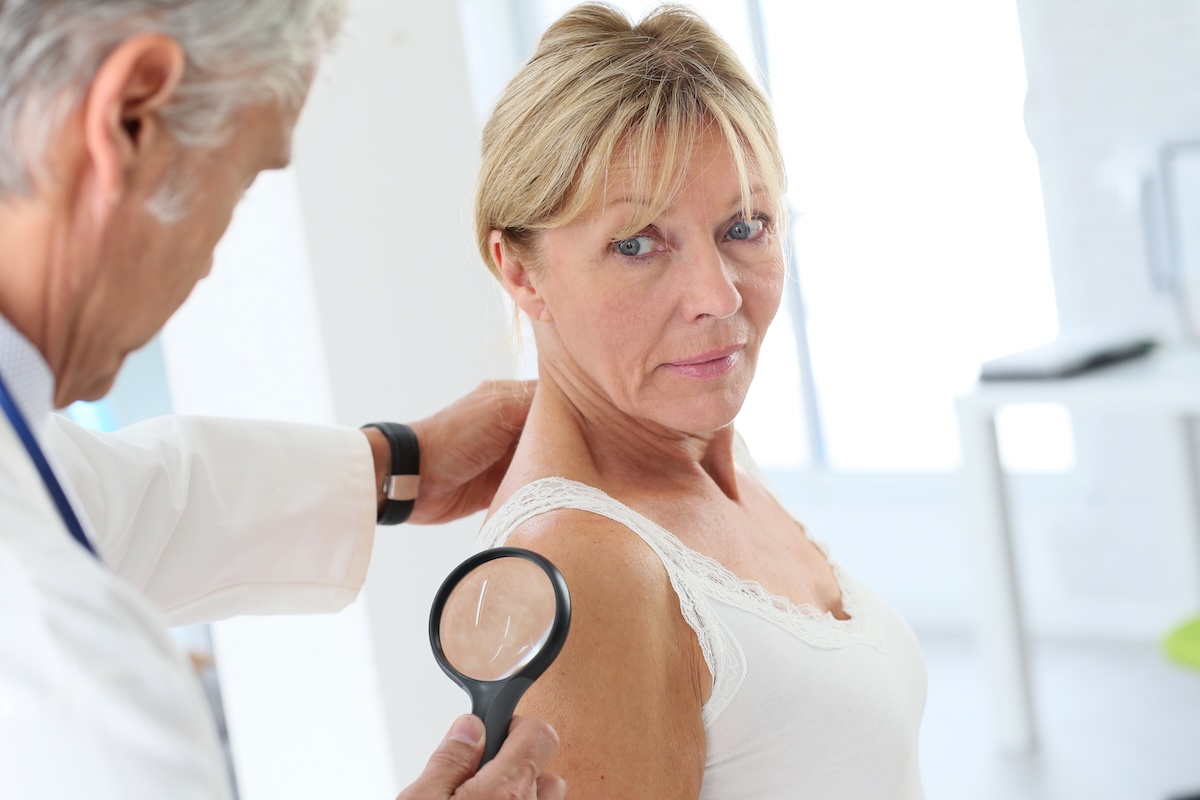
Most AKs can be diagnosed during a skin exam by looking at and feeling the skin, sometimes with a dermatoscope, a lighted magnifier that shows features invisible to the naked eye. AKs can resemble other conditions, including seborrheic keratoses (harmless, waxy “stuck-on” growths), patches of eczema or dermatitis, and early skin cancers.
If a spot is thick, tender, growing quickly, bleeding, or hasn’t responded to treatment, your provider may recommend a quick biopsy to make sure it isn’t already a squamous cell carcinoma.
Treatment Options for Actinic Keratosis
Treatment depends on how many AKs you have, where they are, how thick they are, and what fits your schedule. There are two main approaches, and many patients use both.
Treating Individual Spots
- Cryotherapy (liquid nitrogen). The most common treatment for a few scattered AKs. Your provider freezes each spot in the office, which takes seconds. The area may blister or scab, then heals over one to three weeks. It can leave a small lighter patch of skin.
- Curettage. Thicker AKs may be gently scraped away under local anesthetic, which also lets the tissue be checked under a microscope.
Treating a Whole Area (Field Therapy)
If you have many AKs, or a whole area of sun-damaged skin like the forehead, scalp, or backs of the hands, field therapy treats the visible spots and the damage you can’t see yet. Options include:
- Prescription creams such as 5-fluorouracil (5-FU), imiquimod, and tirbanibulin. These are applied at home for a set number of days or weeks, depending on the medication.
- Photodynamic therapy (PDT), in which a light-sensitizing solution is applied to the skin and then activated with a special light.
- Chemical peels and laser resurfacing, which can remove a layer of sun-damaged skin in selected patients.
With most field treatments, the skin gets red, scaly, and crusted for a while before it heals. That reaction is expected and usually means the treatment is working on damaged cells. Many patients choose to do field therapy in the colder months, when they spend less time outdoors and a red forehead is easy to hide under a hat.
Seeing Dr. Glass for Actinic Keratosis
Dr. Jonathan S. Glass is a board-certified dermatologist who diagnoses and treats actinic keratoses and skin cancer, along with a wide range of other skin conditions. He earned his medical degree at Cornell, completed his dermatology residency at UT Southwestern, and served nine years in the U.S. Navy Medical Corps before joining the faculty at Dartmouth Health.
Dr. Glass also has special expertise in allergic and occupational contact dermatitis, and previously directed the contact dermatitis clinic at Dartmouth Health. That background is useful in AK care. Rough, red patches on the hands and face aren’t always AKs, and field treatments cause intentional irritation that can be hard to tell apart from a true skin allergy. Dr. Glass can sort out which is which, so you get the right treatment and finish it comfortably.
Dr. Glass is accepting new patients. If a spot turns out to be skin cancer, our fellowship-trained Mohs surgeons, Dr. James G. Dinulos and Dr. Dylan Badin, provide Mohs surgery in Portsmouth, Exeter, and Bedford.
After Treatment: Preventing New AKs
Treated AKs usually clear, but sun-damaged skin can keep producing new ones for years. Ongoing care makes a real difference:
- Keep up with regular skin checks. Your provider will recommend how often based on your history. For many people with AKs, that’s every 6 to 12 months.
- Wear broad-spectrum SPF 30 or higher every day on your face, ears, neck, and hands, all year round.
- Use a lip balm with SPF, especially if you’ve had actinic cheilitis.
- Cover up outdoors with a wide-brimmed hat (not a ball cap, which leaves the ears and neck exposed), sunglasses, and sun-protective clothing.
- Ask about nicotinamide. This form of vitamin B3 has been shown to reduce new AKs and some skin cancers in high-risk patients. Talk to your dermatologist before starting it.
When to See a Dermatologist
Make an appointment if you have a rough or scaly spot that keeps coming back, or a lip that stays dry and scaly no matter what you put on it. Come in sooner if a spot:
- Grows quickly or becomes thick and raised
- Becomes tender or painful
- Bleeds, crusts over repeatedly, or turns into a sore that won’t heal
These can be signs that an AK has progressed to squamous cell carcinoma, which is very treatable when caught early.
More Skin Cancer Reading
- I’m At Risk for Skin Cancer — What Should I Do?
- Here’s How Often You Should Do a Skin Check
- Why Is Mohs Surgery So Effective?
- Mohs Surgery Now in Bedford, NH
Dermatology Care Across New Hampshire
Seacoast Dermatology has served the New Hampshire seacoast, Southern Maine, and Massachusetts’ North Shore for more than 40 years, with five offices:
- Portsmouth – Borthwick Ave: 330 Borthwick Ave, Suite 303, Portsmouth, NH 03801 · 603-431-5205
- Portsmouth – Lafayette Rd (Surgical Center): 278 Lafayette Rd, Bldg E, Portsmouth, NH 03801 · 603-431-5205
- Dover: 750 Central Ave, Suite O, Dover, NH 03820 · 603-431-5205
- Exeter (Surgical Center): 1 Hampton Rd, Building B, Suite 208, Exeter, NH 03833 · 603-431-5205
- Bedford (Mohs Surgery): 166 S River Rd, Suite 205, Bedford, NH 03110 · 603-956-6390
Found a rough spot that won’t go away? Call 603-431-5205 (Bedford: 603-956-6390) or schedule an appointment online.